These are my final pieces for the environment side of the project. In the first, I tried to get a swamp-like feel to it, to give it a desolate and stagnating sense, without having the structures collapsing.
In the second piece, based on Nigel's advice, I painted more roughly to begin with, adding details in layers, instead of trying to put all the detail in at once. I also decided to put my character in this piece as it seems more fitting for the witch to be praying in a spooky scene than in a stagnating, overgrown area.
Showing posts with label The Tinderbox. Show all posts
Thursday, 21 November 2013
Tuesday, 19 November 2013
The Witch Final Piece
My final piece for the character creation part of the project. I decided to have the witch holding her veil, so that you could see her face, instead of her wearing it and obscuring her. Additionally, I changed the scene slightly, bringing the scene further towards the witch, drawing more attention to her, and also changing the position of the cherry blossom tree in the background, so that the light shining on her has more context.
Environment Final Pieces: Sketch
The rough layout for my final pieces. I decided to change a few aspects of the second one, because I liked the general idea of the piece, but the background was very boring and it didn't really make sense to have the surrounding area be land when the bridge was the central part of the scene.
Monday, 11 November 2013
Environment Studies
For the second part of BA1, we need to produce two finished pieces, in full colour. Similarly to the last project, we develop our ideas through the stages of lineart, value studies, and colour studies, before starting the final pieces.
Lineart Pieces
Value Studies
Colour Studies
Tuesday, 5 November 2013
Final Piece Sketch
Rough colours and layout of my final piece. I wanted a slightly dilapidated and overgrown appearance for the piece, given that my witch was exiled, so I decided on an old shrine, specifically a bridge nearby. Because the scene was quite big, I'm going to make use of strong light and contrast to highlight my character.
I narrowed down the image in my value study to put more focus on the witch's position.
Sunday, 3 November 2013
Witch Character Sheets
The main thing that I wanted to portray with this character was her determination to rejoin her society, and so I decided to show her largely stone-faced, aside from when she is looking to the sky in the first full-body model.
Tuesday, 29 October 2013
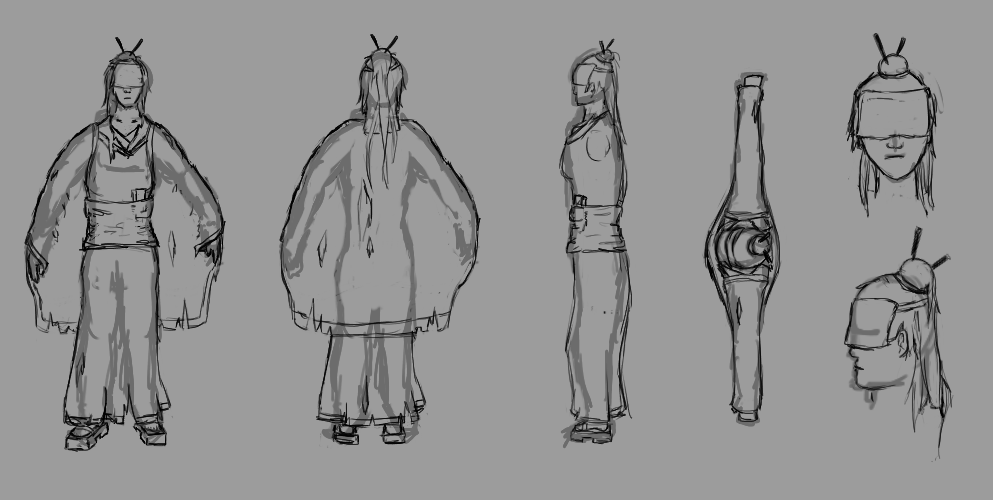
Witch Model Sheet
I decided that instead of building my final character directly from my colour studies, I would combine elements from all of my ideas into a character that I felt best represented my interpretation of the witch.
I really liked the idea of the witch covering her face that was in my final colour study, however I felt that if she was covering her own face, it would be very difficult to be able to show any emotion from her, and that wouldn't give the impression of the determined, but ultimately broken character, determined to regain her family's honour.
Additionally, I made her kimono more damaged, ripped and torn in various places, showing how long she has been in the wilderness and away from society. In the same vein, some of her hair is in a traditional bun, held together with kanzashi pins, however strands of hair have fallen out of place and trail behind her.
I also added a version of her face without the veil, seeing as she wouldn't always be able to wear it.
![]() |
| Final Colours |
Sunday, 27 October 2013
Witch Colour Studies
Colour studies and variations, based off of the value studies I did previously. I initially went for bright colour schemes, as most kimonos feature bright patterns, however in my later colour studies I decided against this, as being a witch living in the wilderness outside the town, it is unlikely that her clothes would still be pristine. Instead, they would be sun-bleached, dirty, and possibly even torn, and so I decided on a much more muted colour scheme in the later designs.
Wednesday, 23 October 2013
Witch Value Studies
Taking the three of my favourite silhouettes, I created these value studies, clarifying the details of the figure, pose and clothes. My designs are more traditional figures for the time, despite my character being the Witch. Given the time period, I was drawn to the idea of the Witch being not a magical creature linked to the mythology of the time, which I initially considered, and instead a woman who was cast out of the village because of her family's shame.
Honour was incredibly important to the Japanese, particularly in this period, and shamed samurai would be expected to commit seppuku. In my version of The Tinder-Box, the Witch's father, a samurai, was ruled to commit suicide, and she, through both the shame she had for her father, and the village's disdain for her family's lack of honour, left her home to live in the wilderness. Suspecting the Tinder-Box's power, because of local legends and myths, she waited for someone to retrieve it for her in the hopes she could recompense for her father's shame and rejoin the village as an equal, despite the unlikeliness of that situation.
In this study, the Witch appears in more regal attire, although her kimono, having been dragged along the ground for so long, has frayed and ripped. Her hairstyle, a traditional bun, has also become loose as time has progressed, with her long hair trailing strands behind her as she walks.
In this study, my figure was more decrepit, needing a support to help her walk. Instead of going for a traditional cane or stick, I decided to design something a little more exaggerated, basing the support from the traditional red gates, Torii.
Here, I decided to have the witch hide her face, as part of her shame for herself. Until she can restore her family's honour, she will not allow others to see her face, deeming herself unworthy to be looked upon. She also holds a long stick, to aid her walking, although this is much simpler than in the previous study.
Friday, 18 October 2013
The Witch Silhouettes
I had originally decided on the soldier as my character, however after doing around 35 of them, I wasn't happy with the outcome, and so decided to instead work on the witch, which I am much happier with.
In my silhouettes, I tried to get a mixture of more traditional decrepit old women, and more generic women, so that my ideas weren't solely limited to one design this early on.
Tuesday, 15 October 2013
Research: Edo Japan
For my first project in Concept Visualisation; Character Creation, I have been given the period of Edo Japan to study. From this period, and based on the Tinder-Box, I will create at least 50 character silhouettes, from which I will create value studies and colour variations. Based on these, I will then design a model sheet (side, front, back, etc. views), character sheets, and finally, a finished character piece, complete with background.
Below is my first pages of research, in which I look at clothing, hairstyles, accessories, and weapons. At this point, I was still unsure about which of the characters of Hans Christian-Andersen's story to base my designs on, and so the research is more generalised.
Thursday, 10 October 2013
The Tinder-Box
Despite reading some of Hans Christian Andersen's short stories before, I came away from The Tinder-Box quite confused. Having been expecting an ending with a strong moral (in a similar vein to The Girl Who Trod on the Loaf), it was a little surprising when the Soldier, set up to be the perfect Veruca Salt-style character, wasn't undone by his own greed.
The story begins with a soldier coming back from war, when he meets a witch by a great tree. The witch tells him of a hall beneath the tree, containing unimaginable riches. The witch offered to lower him into the tree in exchange for her tinderbox, which was also in the hall. The soldier descends, and in the first room, finds a chest full of copper pieces, guarded by a dog with teacup-sized eyes. After moving the dog, he fills his pockets with copper, and proceeds to the next chamber. In there, he moves the second dog, with mill-wheel-sized eyes, and empties his pockets of copper, replacing them with silver. In the third room, the soldier repeats this, instead with gold pieces, and then, tinderbox in hand, the witch brings him back up.
He asks the witch what she will do with the tinderbox, and when she refuses to tell him, he decapitates her, bringing the tinderbox with him. In the nearby town, he lives in luxury, until, after a while, the money he took from the hall was gone. Upon striking the tinderbox to light a small candle, the dog that guarded the copper pieces appeared before him. The dogs that the box called to him would fulfil his every wish, and so, when he wishes to see the princess, who is locked in a copper tower, the first dog brings her to him. The king, fearing that his daughter would fall in love with a commoner, tasks one of the servants with watching over the princess. When the dog takes her the next night, the servant follows, drawing a large cross on the soldier's door with chalk.
When the soldier sees the chalk cross, he takes chalk and draws a cross on the doors of all the other houses in town, in order to conceal himself, and so, when the king and queen look the next morning, they cannot find the correct house. That evening, the queen ties a bag of flour around the princess' neck and cuts a hole in it, so that they could follow the trail she left when she was taken. Sure enough, the next morning, the soldier is identified and arrested, to be hanged later. The soldier pays a shoemaker's boy to fetch the tinderbox for him, and so when he is to be hanged, he requests to smoke a pipe one last time. Of course, on striking the tinderbox, the three dogs appear, and, upon the soldier's request, kills the soldiers, king and queen. The villagers, terrified, proclaim him king, and allow him to marry the princess, after which she becomes queen. (This, apparently, she is pleased with, despite her husband brutally murdering her mother and father to gain his position.)
...and the story ends there, something I hadn't been expecting. Whilst the soldier was very clever; drawing the crosses on the other houses' doors and persuading the executioner to allow him to strike the tinderbox, his greed and willingness to murder both the monarchy and the witch, made me feel as though he was the morally worst character in the story, and yet he receives everything he wishes for. On the other hand, he took opportunities as and when they were presented; he descended into the hall despite the fact that the witch could have simply dropped him to his death, he killed the witch who, potentially, could have used the tinderbox to kill him and take the gold, he used the shoemaker's boy to retrieve the tinderbox, and finally, he escaped his execution to live a life as king. In that way, you could take the moral to be that those who act on opportunities are successful, however I do feel that I am trying to find a moral in a story that is simply meant to be enjoyed for what it is.
Subscribe to:
Posts (Atom)